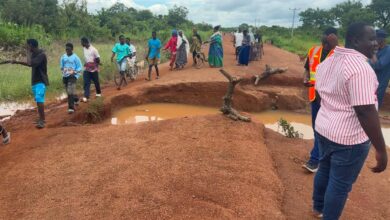
‘The factory is there, but we are not benefiting’ – Kpandai women return to manual gari processing

-800x446.webp)
Clara Kinyinkyde, 29, begins her day before the roosters crow. She dress up, lights the fire under the metal frying pan, and settles into the hours of labour that define her life.
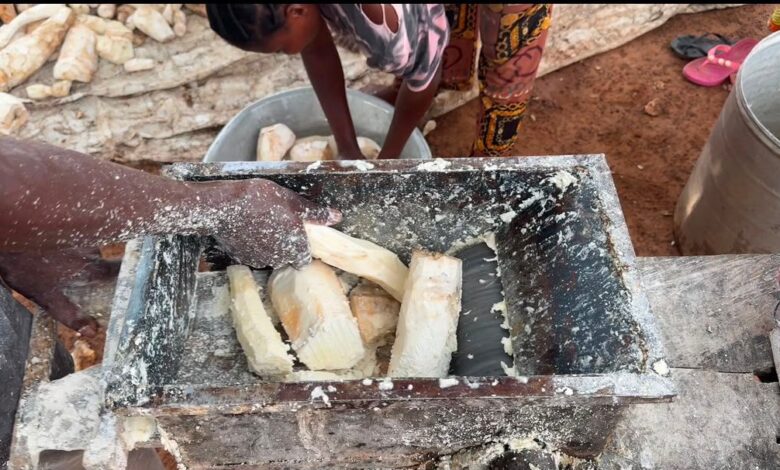
Before the sun lifts over the Balai horizon, the women are already at work. Their hands move in a rhythm they know too well: peel, wash, grate, press, fry.
By midday, their backs ache, their eyes sting from smoke, and their knuckles are stained pale brown from cassava sap.
A few metres away, a modern cassava-processing factory stands quiet. Its machines do not hum. Its gates are locked. And the promise it carried of easier work, better pay, and relief from the drudgery feels like a dream that faded with the morning mist.
.jpg)
Dawn in Balai: The work that never changed
Clara Kinyinkyde, 29, begins her day before the roosters crow. She dress up, lights the fire under the metal frying pan, and settles into the hours of labour that define her life.
“Sometimes we start early in the morning and work until evening,” she says, wiping sweat from her brow.
“Even after working for many hours, we cannot process enough cassava. The work is very hard, especially for the women.”

Clara is one of dozens of processors in Balai and surrounding communities Enk, Kanchina, Lunto, Loduto, Kabauli, Kitari, Chakori, Jambuay who still rely on the manual method. For them, gari processing is not just work; it is survival. But it is also a cycle of exhaustion that leaves little room for rest, growth, or hope.
A promise commissioned, then paused
The factory was commissioned on December 22 and handed over to the Kpandai District Assembly under the Rural Enterprise Programme (REP), part of the Ministry of Trade and Industry’s One District, One Factory (1D1F) initiative.
It was meant to transform the local cassava value chain: reduce the physical burden on women, create jobs, improve incomes, and offer a ready market for farmers. For a few weeks, that promise felt real.
.jpg)
“We were happy when they built the factory because we thought the machines would help us,” Clara says. “We worked for some weeks, but payment became a problem. We were told to go home and that they would contact us. But they have not contacted us, so we returned to our old way of producing gari.”
The arrangement collapsed over payment disputes, and the women were sent home. No timeline. No explanation. Just silence.
The cost of waiting
For Madam Mary, another processor, the factory’s closure is more than an economic setback. It is a return to a life she had hoped to leave behind.
“We thought the factory would make our work easier and help us earn more money,” she says. “But because it has closed down, we have gone back to the old way of processing gari.”
The traditional method is slow and unforgiving. Every stage from peeling to frying is done by hand. The work limits how much gari a woman can produce in a day, and when cassava sits too long before processing, it spoils. That means lost income for farmers and processors alike.

“The factory is there, but we are not benefiting from it,” Madam Mary says. “We are the people doing the processing, and we are the ones suffering. If it starts operating, it will help us and create work for other people.”
Her voice is calm, but her eyes betray frustration. She is not asking for charity. She is asking for the chance to work.
A factory without power
The Assemblyman for the area says the facility was designed to ease the burden on women and shift gari processing from manual labour to a semi-industrial operation. But electricity and equipment challenges have kept it idle.
“Unfortunately, they could not fix that one,” he says. “I think it is the reason they have to use the plant to support it. And so, that is basically the challenge.”
District Chief Executive Haruna Abdul-Karim acknowledges the facility is not fully operational, despite being commissioned.
.jpg)
He raises a question that cuts to the heart of the issue: “We have what we call the commissioning of something, and we also have a question to ourselves: what we have commissioned, is it commissioned to be used for the purpose for which it was built?”
He explains that the factory needs a dedicated transformer and other essential machinery before it can function. The Assembly is engaging the Volta River Authority and other stakeholders to resolve the power challenge.
For the women, these technical explanations offer little comfort. They do not need a transformer. They need their work to matter. They need the machines to move.

An operational factory would mean shorter processing times, higher production, and relief from the physical demands of working beside smoky fires. It would mean their children could go to school while they work, instead of watching their mothers strain under the weight of cassava sacks.
But until the electricity and equipment challenges are resolved, those benefits remain out of reach.
.jpg)
“We are only asking them to fix the factory’
As the day winds down, the women pack their gari into sacks and carry them home. Their hands are stained, their clothes smell of smoke, and their bodies ache. But their resolve is intact.
“We are only asking them to fix the factory and allow us to work,” Madam Mary says.
In Kpandai, the women wait not for another promise, but for the machines to start moving.